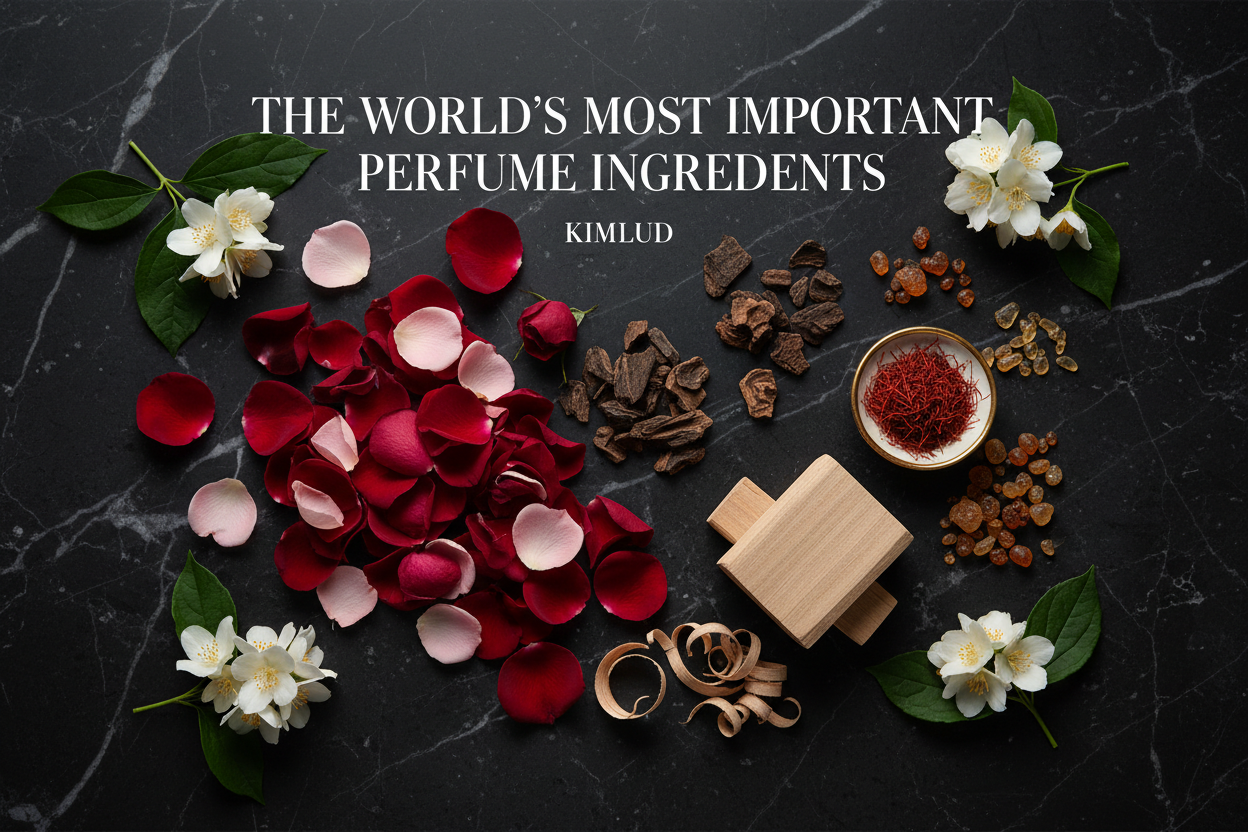
The World's Most Important Perfume Ingredients
The World's Most Important Perfume Ingredients
From the rarest flowers to the most precious woods — a definitive guide to the ingredients that have shaped the history and future of perfumery.
Explore KIMLUD Fragrances
Table of Contents
The Great Florals

Rose (Rosa damascena)
Rose is the single most important floral ingredient in the history of perfumery, appearing in an estimated 75% of all women's fragrances. It takes 3 to 5 metric tonnes of rose petals to produce just one kilogram of rose otto, making it one of the most expensive natural fragrance ingredients. The finest rose otto comes from Bulgaria's Kazanlak Valley and from Taif, Saudi Arabia.
Jasmine (Jasminum grandiflorum / Jasminum sambac)
Jasmine is the second most important floral ingredient in perfumery. It takes approximately 7 to 8 million jasmine flowers to produce one kilogram of jasmine absolute. Its intensely floral, slightly animalic, indolic character gives fragrances depth, warmth, and a distinctive "living flower" quality.
Iris / Orris (Iris pallida)
Orris butter — from iris rhizomes dried for 3 to 5 years in Florence, Italy — has a distinctive powdery, violet-like character central to many classic perfumes including Chanel No. 5. It can cost $50,000 to $100,000 per kilogram.
Ylang-Ylang (Cananga odorata)
A tropical flower cultivated primarily in the Comoro Islands and Madagascar, with an intensely sweet, floral, slightly rubbery character. A key component of Chanel No. 5.
Tuberose (Polianthes tuberosa)
One of the most intensely fragrant flowers in the world, with a creamy, narcotic character. Famous tuberose fragrances include Fracas by Robert Piguet and Carnal Flower by Frederic Malle.
Precious Woods

Oud / Agarwood (Aquilaria spp.)
The most expensive natural fragrance ingredient in the world at over $80,000/kg for the finest grades. Deep, complex, multi-layered — the most important ingredient in Arabian perfumery.
Sandalwood (Santalum album)
Prized for its creamy, warm, milky, woody character that blends harmoniously with virtually every other aromatic material. The finest comes from Mysore, India. The traditional base for Indian attars.
Vetiver (Chrysopogon zizanioides)
A grass cultivated primarily in Haiti, Reunion, and Java for its aromatic roots. Complex, smoky, earthy, woody — one of the most important base notes in perfumery.
Cedarwood & Patchouli
Cedarwood provides a clean, woody foundation. Patchouli — earthy, dark, slightly sweet — is a key ingredient in Angel by Thierry Mugler and countless oriental compositions.
Resins and Balsams
Frankincense (Boswellia sacra) adds depth and spirituality. Benzoin contributes warm, vanilla-like sweetness. Labdanum — from the rock rose — is the primary natural source of the "amber" note in perfumery.
Musks
| Musk Type | Character | Examples |
|---|---|---|
| Nitro musks | Powdery, sweet (largely phased out) | Musk ambrette |
| Polycyclic musks | Clean, fresh, laundry-like | Galaxolide, Tonalide |
| Macrocyclic musks | Clean, natural, skin-like | Habanolide, Exaltolide |
Citrus Ingredients
| Ingredient | Source | Character |
|---|---|---|
| Bergamot | Calabria, Italy | Fresh, citrusy, floral, slightly spicy |
| Lemon | Sicily, Spain | Sharp, clean, bright citrus |
| Neroli | Tunisia, Morocco | Floral, fresh, slightly bitter orange blossom |
| Grapefruit | USA, Israel | Fresh, slightly bitter, juicy |
Spices
| Spice | Character | Famous Uses |
|---|---|---|
| Cardamom | Warm, spicy, slightly eucalyptus | Arabian perfumery, orientals |
| Saffron | Spicy, leathery, honeyed | Arabian perfumery, luxury orientals |
| Black Pepper | Dry, spicy, slightly woody | Modern masculine fragrances |
| Cinnamon | Warm, sweet, spicy | Oriental compositions |
Animal-Derived Ingredients
| Ingredient | Character | Status Today |
|---|---|---|
| Ambergris | Sweet, musky, oceanic, animalic | Legal (found floating), extremely expensive |
| Musk | Warm, animalic, sensual | Banned — replaced by synthetics |
| Civet | Intensely animalic, fecal, musky | Banned — replaced by synthetics |
| Castoreum | Leathery, smoky, animalic | Restricted — rarely used |
Revolutionary Synthetic Molecules
| Molecule | Developed | Character | Significance |
|---|---|---|---|
| Coumarin | 1868 | Hay-like, sweet, vanilla | First major synthetic — created the fougere family |
| Aldehydes | Early 1900s | Soapy, waxy, powdery | Defined Chanel No. 5 |
| Iso E Super | 1973 | Woody, cedar, skin-like | Most widely used molecule in modern perfumery |
| Ambroxan | 1950s | Warm, woody, ambergris-like | Most popular modern base note |
| Calone | 1966 | Marine, fresh, ozonic | Created the aquatic fragrance family |
The World's Rarest Ingredients
| Ingredient | Why It's Rare | Approximate Price |
|---|---|---|
| Kynam Oud (Vietnamese) | Rarest grade of agarwood, almost never available | $100,000+/kg |
| Orris Butter | Requires 3–5 years drying, extremely low yield | $50,000–$100,000/kg |
| Taif Rose Oil | 3–4 week season, 10,000 flowers per tola | $30,000–$50,000/kg |
| Ambergris | Found floating at sea, extremely rare | $10,000–$50,000/kg |
| Rose Otto (Bulgarian) | 3–5 tonnes petals per kg oil | $10,000–$15,000/kg |
| Jasmine Absolute (Grasse) | 7–8 million flowers per kg, hand-harvested | $5,000–$10,000/kg |
Frequently Asked Questions
What is the most expensive perfume ingredient?
Kynam oud from Vietnam, with prices exceeding $100,000 per kilogram. Orris butter and Taif rose oil are also among the most expensive.
What is ambergris?
A waxy substance from sperm whale intestines, found floating at sea. Sweet, musky, oceanic — one of the most prized natural fixatives in perfumery.
Why is orris butter so expensive?
Iris rhizomes must be dried for 3 to 5 years before developing their aromatic compounds, and the yield is extremely low.
Is jasmine or rose more important in perfumery?
Both are equally fundamental. Rose appears in approximately 75% of women's fragrances. Jasmine is considered by many perfumers to be the most versatile floral ingredient.
Continue Reading: KIMLUD Fragrance Authority Series
References & Further Reading