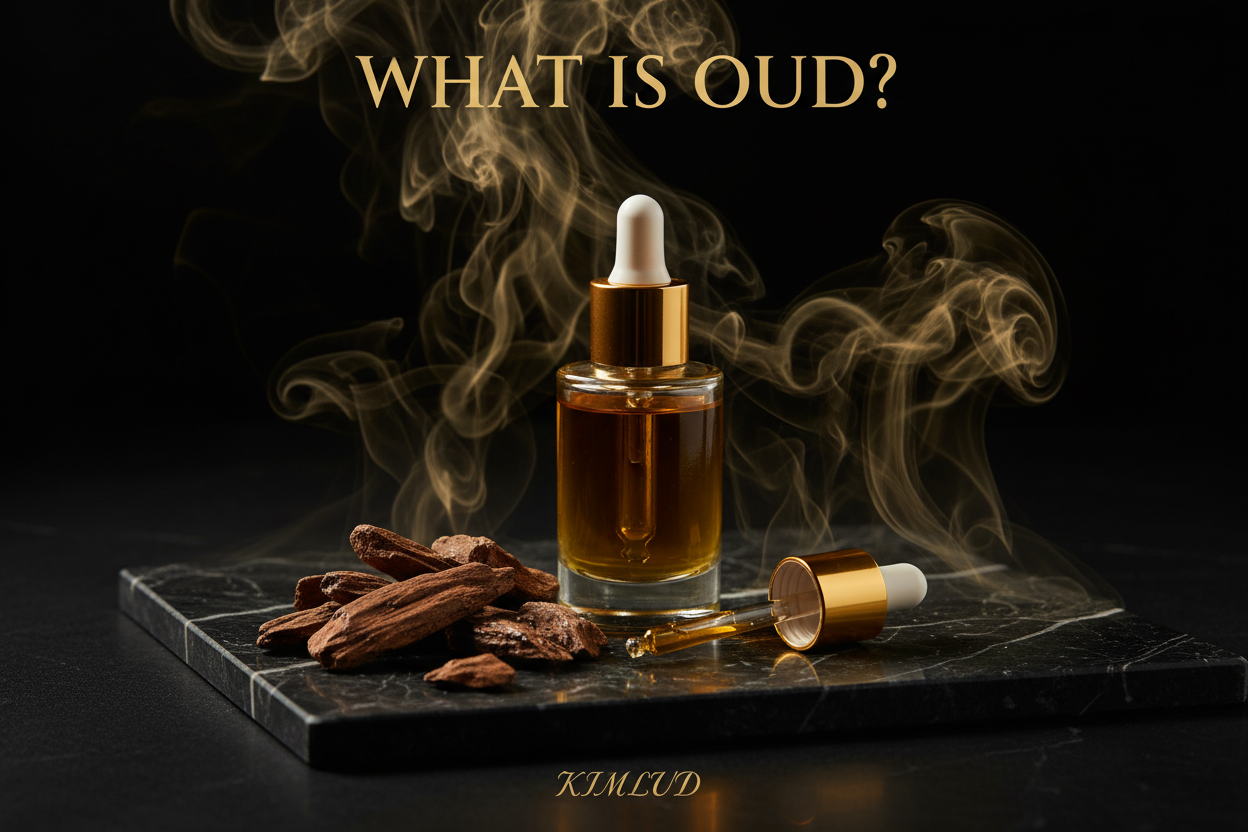
What Is Oud? The Complete Guide to the World's Most Precious Fragrance Ingredient
What Is Oud? The Complete Guide to the World's Most Precious Fragrance Ingredient
From ancient temples to modern luxury perfumery — discover the extraordinary story of oud, the liquid gold of the fragrance world.
Explore KIMLUD FragrancesTable of Contents
What Is Oud?
Oud — also known as agarwood, aloeswood, or oudh — is one of the most rare, complex, and expensive natural fragrance ingredients in the world. It is a dark, resinous heartwood that forms inside the trunk of Aquilaria trees, a genus of large evergreen trees native to Southeast Asia and parts of South Asia and the Middle East.
What makes oud extraordinary is not the tree itself, but what happens when the tree becomes infected. When an Aquilaria tree is attacked by a specific mold — Phialophora parasitica — it produces a dark, fragrant resin as a defense mechanism. This resin saturates the heartwood over decades, transforming it into the precious material known as agarwood or oud.
The resulting wood is extraordinarily dense, dark, and intensely aromatic. When burned or distilled, it releases a complex, multi-layered scent that has captivated civilizations for thousands of years. Oud oil — extracted through steam distillation — can cost anywhere from $5,000 to over $80,000 per kilogram, making it one of the most expensive natural substances on Earth, often referred to as liquid gold.
How Oud Forms in Nature
The formation of oud is one of nature's most remarkable alchemical processes. It begins with a healthy Aquilaria tree — a fast-growing tropical evergreen that, in its natural state, has pale, odorless heartwood. The transformation into oud requires a very specific set of conditions.
When the tree is wounded — whether by insect damage, physical injury, or fungal infection — it responds by producing a dark oleoresin. This resin is the tree's immune response, designed to seal the wound and fight the infection. Over time, as the resin continues to accumulate and the wood becomes increasingly saturated, the heartwood darkens and becomes dense with aromatic compounds.
This process takes years — sometimes decades. The older the infection and the more saturated the wood, the higher the quality and value of the resulting oud. The finest grades of wild oud come from trees that have been producing resin for 50 to 100 years or more.
| Stage | Process | Duration | Result |
|---|---|---|---|
| 1. Healthy Tree | Normal growth, pale heartwood | 10–20 years | No oud |
| 2. Infection | Fungal/insect attack triggers resin | Months | Resin begins forming |
| 3. Resin Accumulation | Heartwood darkens and saturates | 10–50 years | Low to mid-grade oud |
| 4. Deep Saturation | Full heartwood transformation | 50–100+ years | Premium grade oud |
The Ancient History of Oud
Oud has been treasured by human civilizations for at least 3,000 years. Its history spans continents, religions, and cultures — from the temples of ancient India to the royal courts of Arabia, from the incense rituals of Japan to the luxury perfumeries of contemporary Paris.
Oud in Ancient India and Sanskrit Texts
Some of the earliest recorded references to agarwood appear in ancient Sanskrit texts, including the Vedas and the Charaka Samhita, one of the foundational texts of Ayurvedic medicine. In these texts, agarwood — known as agaru — is described as a sacred substance used in religious ceremonies, medicinal preparations, and royal rituals. It was burned as incense in temples dedicated to Hindu deities and used in Ayurvedic treatments for its believed healing properties.
Oud in Ancient China and the Kōdō Tradition
Agarwood arrived in China along the ancient Silk Road trade routes, where it became known as chénxiāng (沉香), meaning "sinking incense" — a reference to the wood's density, which causes it to sink in water, unlike most woods. Chinese emperors prized agarwood as a luxury commodity, and it was burned in imperial courts and Buddhist temples alike.
In Japan, the appreciation of agarwood evolved into a refined cultural practice known as kōdō (香道) — the Way of Incense. Developed during the Heian period (794–1185 CE), kōdō is one of Japan's three classical arts of refinement, alongside the tea ceremony and flower arranging. Practitioners of kōdō would "listen" to the incense — a meditative practice of deeply experiencing the scent of burning agarwood.
Oud in the Islamic World
In Islamic tradition, oud holds profound spiritual significance. The Prophet Muhammad is reported to have recommended the use of Indian oud for its healing properties, and oud incense has been burned in mosques and homes across the Arab world for centuries. In the Gulf states — particularly Saudi Arabia, the UAE, Kuwait, and Qatar — oud is deeply embedded in cultural identity. Burning oud chips (bakhoor) to perfume the home and clothing is a daily ritual for many families, and gifting fine oud is a gesture of the highest respect and generosity.
Oud in the Middle East Today
The Arabian Peninsula remains the world's largest consumer of oud. In countries like Saudi Arabia and the UAE, oud is not merely a fragrance — it is a cultural institution. The finest oud chips are burned on charcoal in ornate incense burners (mabkhara), and oud oil is applied directly to the skin and clothing. The oud market in the Gulf region alone is worth billions of dollars annually.
Types of Oud Around the World
Not all oud is the same. The geographic origin of the Aquilaria tree, the species, the age of the infection, and the extraction method all profoundly influence the character and quality of the resulting oud. Connoisseurs distinguish between ouds from different regions the way wine experts distinguish between vintages and terroirs.
| Origin | Character | Notes | Prestige Level |
|---|---|---|---|
| Hindi (India) | Deep, animalic, barnyard, leathery | Dark, smoky, complex | ⭐⭐⭐⭐⭐ |
| Cambodian | Sweet, fruity, floral | Lighter, approachable | ⭐⭐⭐⭐ |
| Malaysian | Woody, earthy, slightly sweet | Balanced, versatile | ⭐⭐⭐⭐ |
| Indonesian (Borneo) | Earthy, green, slightly medicinal | Raw, powerful | ⭐⭐⭐⭐ |
| Vietnamese (Kynam) | Ethereal, sweet, cooling, complex | Rarest and most prized | ⭐⭐⭐⭐⭐ |
| Papua New Guinea | Fresh, green, woody | Lighter profile | ⭐⭐⭐ |
| Thai | Floral, sweet, slightly spicy | Elegant, refined | ⭐⭐⭐⭐ |
Oud in Modern Perfumery
While oud has been central to Middle Eastern and Asian perfumery for millennia, it only began to capture the imagination of Western perfumers in the late 20th and early 21st centuries. Today, oud is one of the most sought-after ingredients in global luxury perfumery, appearing in fragrances from houses including Tom Ford, Dior, Chanel, Guerlain, Maison Francis Kurkdjian, and many others.
The Western discovery of oud was largely driven by the growing influence of Middle Eastern luxury culture and the work of pioneering perfumers who recognized oud's extraordinary complexity. Tom Ford's Oud Wood, launched in 2007, is widely credited with introducing oud to mainstream Western audiences. Since then, the global oud fragrance market has grown exponentially.
In perfumery, oud functions primarily as a base note — its deep, resonant character anchors a fragrance and gives it extraordinary longevity. Oud blends beautifully with rose (a classic pairing in Arabian perfumery), sandalwood, amber, musk, saffron, and leather. It can be used to add depth and mystery to floral compositions, or to create intensely powerful, statement fragrances.
Natural Oud vs Synthetic Oud
Given the extreme rarity and cost of natural oud, the fragrance industry has developed a range of synthetic oud molecules designed to replicate its character at a fraction of the cost. The most widely used synthetic oud molecules include Iso E Super, Javanol, and various proprietary agarwood accords developed by fragrance ingredient companies such as Givaudan, Firmenich, and IFF.
| Feature | Natural Oud | Synthetic Oud |
|---|---|---|
| Cost | $5,000–$80,000+/kg | $50–$500/kg |
| Complexity | Hundreds of aromatic compounds | Limited molecular profile |
| Consistency | Varies by origin and batch | Highly consistent |
| Sustainability | Endangered species concerns | Environmentally neutral |
| Longevity on skin | Exceptional (12–24 hours) | Good (6–12 hours) |
| Authenticity | Full spectrum complexity | Approximation of character |
What Does Oud Smell Like?
Describing the scent of oud is one of perfumery's great challenges — it is simultaneously ancient and modern, earthy and ethereal, animalic and spiritual. No single description can capture its full complexity, which is part of what makes it so endlessly fascinating to perfumers and fragrance lovers alike.
At its core, oud has a deep, woody character with strong resinous undertones. Depending on its origin and quality, it can express notes of:
- Dark wood — dense, rich, almost smoky
- Leather — animalic, warm, slightly dry
- Earth — forest floor, damp soil, moss
- Sweetness — dried fruit, honey, vanilla (especially in Cambodian and Thai ouds)
- Spice — pepper, cardamom, subtle warmth
- Floral — rose-like facets, especially in Vietnamese kynam
- Incense — sacred, meditative, temple-like
The finest ouds are described by connoisseurs as having a living quality — as if the fragrance breathes and evolves on the skin over hours, revealing new facets as it dries down.
Oud, Luxury, and Fashion
In the world of luxury fashion and lifestyle, oud has become a powerful symbol of sophistication, cultural depth, and refined taste. The association between oud and luxury is ancient — for centuries, oud was reserved for royalty, religious leaders, and the very wealthy. Today, that association remains intact, even as oud has become more accessible through the work of contemporary perfumers.
For the modern woman who appreciates luxury fashion, oud offers a fragrance experience that is unlike anything in the Western perfumery canon. It is bold, complex, and deeply personal — a scent that makes a statement without saying a word. Paired with a beautifully tailored dress or an elegant evening coat, an oud fragrance completes a look with an invisible but unforgettable signature.
At KIMLUD, we believe that true luxury is multisensory. The clothes you wear, the way you carry yourself, and the fragrance you choose all contribute to the complete expression of your personal style. Oud, with its extraordinary history and unparalleled complexity, is the ultimate luxury fragrance choice for the woman who knows exactly who she is.
How to Wear Oud Fragrance
Oud is an intense fragrance ingredient, and wearing it well requires a degree of intention and knowledge. Here are the essential guidelines for wearing oud fragrance with confidence and elegance.
- Apply to pulse points: Wrists, neck, behind the ears, and the inner elbows are ideal application points. The warmth of these areas helps to diffuse the fragrance and develop its complexity.
- Less is more: Oud is powerful. One or two sprays of an oud-based eau de parfum, or a small amount of oud oil applied with a rollerball, is typically sufficient.
- Layer thoughtfully: In Arabian tradition, oud is often layered — oud oil applied to the skin, followed by an oud-based spray, and then bakhoor burned to perfume the clothing. This creates a rich, enveloping fragrance experience.
- Allow it to develop: Oud fragrances evolve significantly over time. The opening may be intense and resinous, but the dry-down often reveals extraordinary sweetness and complexity. Give the fragrance at least 30 minutes to fully develop before judging it.
- Season and occasion: Oud is particularly well-suited to cooler weather and evening occasions. Its depth and warmth make it a natural choice for autumn and winter, and for formal or intimate settings.
Sustainability and Oud
The extraordinary demand for oud has placed enormous pressure on wild Aquilaria tree populations. Several species of Aquilaria are now listed as endangered or vulnerable on the IUCN Red List, and the trade in wild agarwood is regulated under CITES (the Convention on International Trade in Endangered Species).
In response to these conservation concerns, a significant agarwood cultivation industry has developed across Southeast Asia, particularly in Vietnam, Cambodia, Malaysia, and Indonesia. Cultivated agarwood — produced by artificially inoculating Aquilaria trees with the infection-causing fungus — now accounts for the majority of commercially available oud. While cultivated oud is generally considered less complex than the finest wild oud, advances in cultivation techniques are producing increasingly high-quality material.
When choosing oud fragrances, look for brands that are transparent about their sourcing and committed to sustainable practices. The future of oud depends on the industry's ability to balance demand with responsible stewardship of these extraordinary trees.
Frequently Asked Questions About Oud
What is oud made from?
Oud is made from the resin-saturated heartwood of Aquilaria trees. The resin forms when the tree becomes infected with a specific mold, producing a dark, aromatic wood that is then distilled into oud oil or burned as incense.
Why is oud so expensive?
Oud is expensive because of its extreme rarity — less than 2% of wild Aquilaria trees naturally produce oud resin — combined with the decades required for the resin to develop, the labor-intensive harvesting process, and the complex distillation required to produce oud oil.
What does oud smell like?
Oud has a complex, multi-layered scent profile that includes deep woody, resinous, leathery, earthy, and sometimes sweet or floral notes. The exact character varies significantly depending on the geographic origin of the wood.
Is oud suitable for women?
Absolutely. While oud has traditionally been associated with masculine fragrances in Western perfumery, it has always been worn by both men and women in Middle Eastern and Asian cultures. Many of the world's most celebrated oud fragrances are unisex or specifically designed for women.
What is the difference between oud oil and oud perfume?
Oud oil is the pure essential oil extracted from agarwood through steam distillation. It is extremely concentrated and applied directly to the skin in very small amounts. Oud perfume is a fragrance composition that uses oud oil or synthetic oud as one ingredient among many, diluted in alcohol.
How long does oud fragrance last?
Natural oud oil applied directly to the skin can last 12 to 24 hours or longer. Oud-based eau de parfum typically lasts 8 to 12 hours. Oud is one of the longest-lasting fragrance ingredients available.
What is bakhoor?
Bakhoor is a traditional Arabian incense made from agarwood chips soaked in fragrant oils and mixed with other aromatic ingredients. It is burned on charcoal in an incense burner called a mabkhara to perfume the home and clothing.
Is oud sustainable?
Wild oud is under significant conservation pressure, with several Aquilaria species listed as endangered. However, a growing cultivated agarwood industry is providing a more sustainable alternative. Look for fragrances that source their oud responsibly.
What fragrances pair well with oud?
Oud pairs beautifully with rose, sandalwood, amber, musk, saffron, leather, and vanilla. The classic oud-and-rose combination is one of the most celebrated pairings in Arabian perfumery.
Where can I find oud fragrances?
Oud fragrances are available from luxury perfume houses, specialist Arabian perfumeries, and curated fashion and lifestyle brands. Explore KIMLUD's fragrance collection for a carefully selected range of oud-inspired and oud-based compositions.