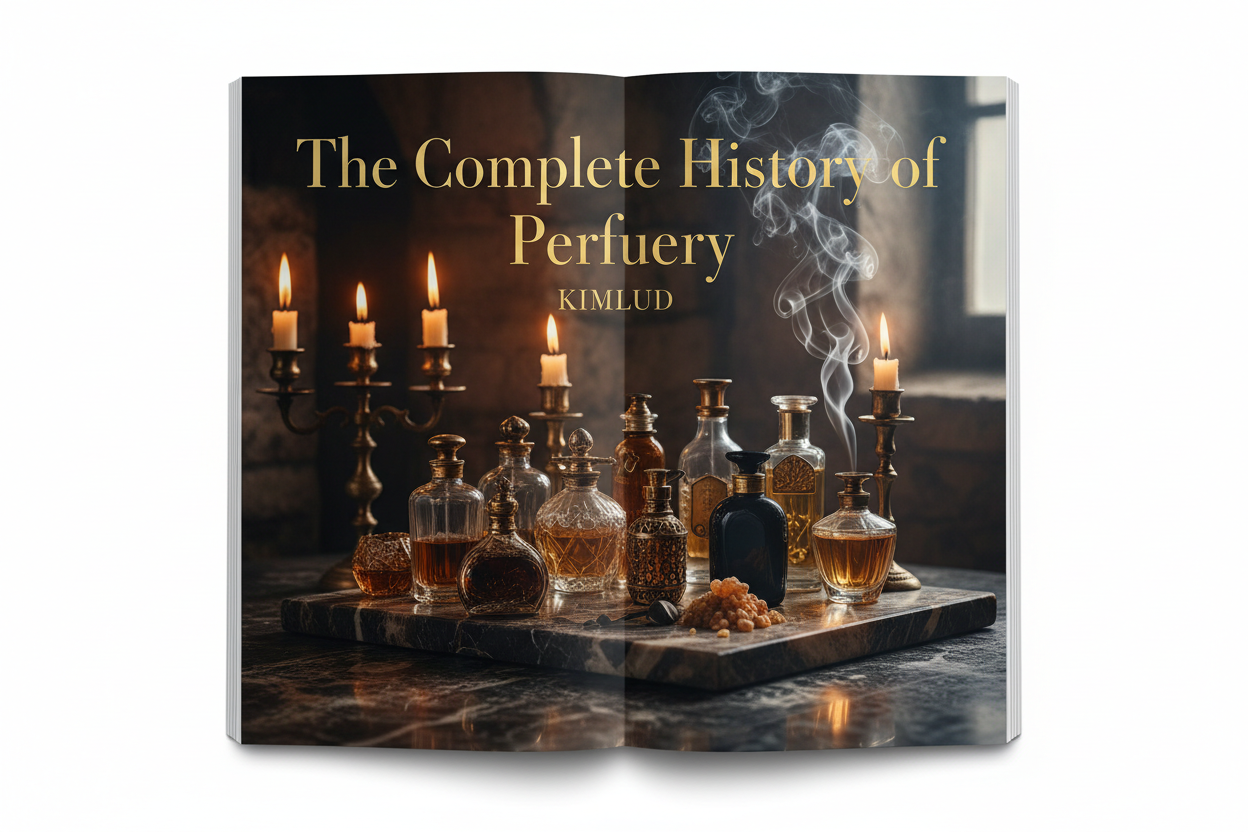
The Complete History of Perfumery: From Ancient Civilizations to Modern Luxury Fragrance
The Complete History of Perfumery
From sacred ancient rituals to modern luxury fragrance — discover how scent shaped human civilization across 7,000 years of history.
Explore Modern Fragrances →📖 Table of Contents
- Introduction: The Story of Perfume Is the Story of Humanity
- 7,000 Years of Perfume: A Historical Timeline
- What Does the Word "Perfume" Actually Mean?
- Before Civilization: The First Fragrances (~5000 BCE)
- Ancient Mesopotamia: The Birthplace of Recorded Perfumery
- Ancient Egypt: The Golden Age of Sacred Perfume
- Ancient India: Perfume as Spiritual Science
- Ancient China: Harmony Through Fragrance
- Ancient Greece: Perfume, Beauty, and Philosophy
- Ancient Rome: Perfume Becomes Mass Luxury
- The Arabic Golden Age: The Scientific Revolution of Scent
- Africa's Ancient Fragrance Traditions
- Indigenous Fragrance Rituals Around the World
- Medieval Europe: Fragrance Against Disease
- The Renaissance: Perfume Returns to Luxury
- France: The World Capital of Perfume
- The Industrial Revolution and Modern Perfumery
- Understanding Fragrance Families: A Complete Guide
- Perfume Concentrations: What the Labels Actually Mean
- The Neuroscience of Perfume
- Beyond Perfume: The Art of Home Fragrance
- Further Reading & Authority Sources
- Frequently Asked Questions
Introduction: The Story of Perfume Is the Story of Humanity

Perfume is far more than a pleasant scent. It is one of humanity's oldest forms of expression, communication, spirituality, medicine, seduction, and identity. Long before modern luxury fragrance houses existed, humans were already burning aromatic woods, crushing flowers, collecting resins, and extracting oils from plants.
The desire to create fragrance appears in nearly every civilization known to history — from prehistoric tribes and ancient temples to royal palaces and modern laboratories. The history of perfume spans more than 7,000 years and follows the evolution of human civilization itself.
Across every culture and every era, perfume has served the same core human needs:
- Religious worship and divine communication
- Healing, medicine, and physical protection
- Social status and royal symbolism
- Courtship, seduction, and intimacy
- Cultural identity and personal expression
- Memory preservation and emotional regulation
Today, the global fragrance industry generates over $50 billion annually — yet its roots remain inseparable from rituals performed thousands of years ago around open fires, in stone temples, and in royal gardens. This is the complete story of perfume.
7,000 Years of Perfume: A Historical Timeline
| Period | Civilization | Key Innovation | Primary Purpose | Signature Ingredient |
|---|---|---|---|---|
| ~5000 BCE | Prehistoric | Aromatic burning | Spiritual ritual | Wild herbs, resins |
| ~4000 BCE | Mesopotamia | First recorded perfumer | Temple & royal use | Flowers, oils, water |
| ~3000 BCE | Ancient Egypt | Kyphi sacred formula | Divine ritual & burial | Frankincense, myrrh |
| ~3000 BCE | Ancient India | Attar distillation | Meditation & Ayurveda | Rose, sandalwood, saffron |
| ~2000 BCE | Ancient China | Incense culture | Philosophy & medicine | Agarwood, sandalwood |
| ~500 BCE | Ancient Greece | Scented oils & cosmetics | Beauty & athletics | Rose, iris, marjoram |
| ~100 BCE | Ancient Rome | Mass luxury perfume | Social status & baths | Imported exotic resins |
| ~900 CE | Arabic Golden Age | Steam distillation | Scientific & spiritual | Oud, amber, rose water |
| ~1400 CE | Medieval Europe | Pomanders & herbal protection | Disease prevention | Cloves, herbs, citrus |
| ~1500 CE | Renaissance | Royal perfumery | Luxury & fashion | Jasmine, musk, civet |
| ~1700 CE | France (Grasse) | Modern perfume industry | Fashion identity | Rose, jasmine, lavender |
| 1800s | Industrial Era | Synthetic molecules | Mass market fragrance | Coumarin, aldehydes |
| 1900s–Today | Global | Niche & luxury houses | Personal expression | All fragrance families |
What Does the Word "Perfume" Actually Mean?
The word perfume comes from the Latin phrase per fumum — meaning "through smoke." This etymology reveals everything about perfumery's origins. Before liquid fragrances existed, before glass bottles and luxury packaging, humans created fragrance through fire. Aromatic materials — frankincense, myrrh, cedarwood, sandalwood, pine resin, dried herbs, and flowers — were burned to produce fragrant smoke believed to carry prayers to the heavens and connect the living with divine forces.
Perfumery was born as a spiritual act. It became a luxury product only much later.
Before Civilization: The First Fragrances in Human History (~5000 BCE)
Archaeological evidence suggests humans were using fragrant plants long before organized civilization emerged. Hunter-gatherer communities likely discovered aromatic materials through fire, cooking, healing practices, and burial rituals. When plants such as sage, cedar, juniper, and sweet grasses were burned, early humans observed their calming, cleansing, and psychoactive effects.
Many prehistoric tribes believed fragrance possessed supernatural powers — the ability to heal the sick, protect the living, and communicate with the dead. These early uses of scent laid the foundation for every perfume tradition that followed.
Ancient Mesopotamia: The Birthplace of Recorded Perfumery (~4000 BCE)
Around 4000 BCE, the civilizations of Mesopotamia — located between the Tigris and Euphrates rivers in modern-day Iraq — developed some of the world's earliest documented perfume practices.
Tapputi-Belatekallim: The World's First Known Perfumer
The first recorded perfume maker in history was Tapputi-Belatekallim, a Babylonian woman who lived around 1200 BCE. Documented on a cuneiform tablet, she is considered the world's first known chemist and perfumer. Using flowers, oils, resins, and water, she developed sophisticated extraction techniques that influenced every civilization that followed.
Discover Modern Fragrances
From ancient resin traditions to contemporary luxury — explore KIMLUD's curated fragrance collection.
Shop Fragrances & Perfumes →Ancient Egypt: The Golden Age of Sacred Perfume (~3000 BCE)

No civilization embraced perfume more completely than Ancient Egypt. For Egyptians, fragrance was not a luxury — it was a theological requirement. Gods were believed to emit divine fragrances, and to honor them, priests burned aromatic substances daily in temples across the Nile.
Kyphi: The World's Most Famous Ancient Fragrance
Kyphi was Egypt's legendary sacred temple fragrance — a complex blend documented in inscriptions at the temples of Edfu and Philae. Its formula included frankincense, myrrh, honey, wine, calamus, juniper, raisins, and aromatic herbs. Kyphi was burned at sunset in temples, used medicinally for anxiety and respiratory conditions, and applied during burial ceremonies to prepare the body for eternity.
The Egyptian hieroglyph for perfume was identical to the hieroglyph for joy. To smell divine was to be divine. Queen Cleopatra reportedly soaked her ships' sails in perfume so that her arrival could be detected before she was seen.
Egyptian-Inspired Luxury Fragrance
Amber, myrrh, and rose — the sacred ingredients of ancient Egypt reimagined for modern luxury.
Explore Amber & Rose Scents →Ancient India: Perfume as Spiritual Science (~3000 BCE)
India developed one of the world's oldest and most sophisticated continuous fragrance traditions — one that remains largely unchanged after 5,000 years. Indian perfumery evolved alongside Ayurveda, making fragrance simultaneously cosmetic, pharmaceutical, and spiritual.
Attar: The World's Purest Natural Perfume
Attar is a natural perfume oil produced through hydro-distillation of botanical materials into a sandalwood base. A single kilogram of rose attar requires over 10,000 kilograms of rose petals. Classic ingredients include rose, jasmine, sandalwood, vetiver, saffron, and oud.
Ancient China: Harmony Through Fragrance (~2000 BCE)
Chinese fragrance traditions emphasized balance, harmony, and inner cultivation. Scholars burned incense while studying and composing poetry — fragrance was a tool for mental clarity and spiritual refinement. The Chinese art of kōdō (the way of incense) elevated fragrance appreciation to a formal aesthetic discipline, comparable to the tea ceremony.
Ancient Greece: Perfume, Beauty, and Philosophy (~500 BCE)
The Greeks inherited fragrance knowledge from Egypt and Mesopotamia and expanded its cultural applications. The philosopher Theophrastus wrote Concerning Odours — one of the earliest systematic texts on fragrance production and the psychology of scent.
Ancient Rome: Perfume Becomes Mass Luxury (~100 BCE)
The Romans transformed perfume from sacred ritual into a lifestyle product consumed across social classes. Emperor Nero reportedly spent the equivalent of millions on rose petals for a single banquet. The Roman Empire's trade routes created the world's first global fragrance supply chain.
The Arabic Golden Age: The Scientific Revolution of Scent (~900 CE)

Between the 8th and 13th centuries, the Islamic world revolutionized perfumery through scientific rigor. The Persian polymath Ibn Sina (Avicenna) (980–1037 CE) perfected steam distillation — the technique that makes modern perfumery possible.
The Arabic perfumery tradition refined four ingredients that remain the pillars of luxury fragrance today: Oud (deep, woody, complex), Amber (warm, resinous, sensual), Musk (animalic, intimate, skin-close), and Rose Water (floral, pure, luminous).
Inspired by Arabian Perfumery Traditions
Oud, amber, and musk — the sacred trilogy of Arabic luxury fragrance, reimagined for modern women.
Shop Oud & Amber Fragrances →Africa's Ancient Fragrance Traditions
Across Africa, aromatic plants served practical, spiritual, and medicinal purposes simultaneously. Different tribes used fragrance for protection, healing, ancestral ceremonies, and initiation rituals. Many of the most prized ingredients in modern niche perfumery — including Somalian frankincense, Madagascan vanilla, and South African buchu — trace directly to these ancient African traditions.
Indigenous Fragrance Rituals Around the World
Every indigenous culture on earth independently developed sophisticated scent traditions. Native American tribes used sage, cedar, and sweetgrass for purification and ceremonial cleansing. Australian Aboriginal communities burned native plants during healing ceremonies. Amazonian tribes used aromatic tree resins for spiritual protection and physical healing.
Every civilization that has ever existed has used fragrance as a bridge between the physical and spiritual worlds.
Medieval Europe: Fragrance Against Disease (~1000–1400 CE)
During the Middle Ages, Europeans believed fragrance could protect against illness. People carried pomanders — perforated metal or ceramic balls filled with aromatic substances — believing the pleasant scent would repel the "bad air" thought to cause plague.
The Renaissance: Perfume Returns to Luxury (~1400–1600 CE)
The Renaissance revived artistic and scientific innovation, and perfumery flourished in the royal courts of Italy, France, and Spain. Catherine de' Medici played a pivotal role in bringing Italian perfumery expertise to France when she married King Henry II in 1533.
France: The World Capital of Perfume (~1600 CE–Present)
France did not invent perfume. But France industrialized it, branded it, and sold it to the world. The town of Grasse in the French Riviera became the global center of perfume production in the 17th century. French innovations include enfleurage, luxury branding (Chanel No. 5, 1921), and the establishment of great perfume houses (Guerlain 1828, Houbigant 1775, Coty 1904).
The Industrial Revolution and the Birth of Modern Perfumery (1800s)
The 19th century introduced synthetic aroma molecules. Key breakthroughs included coumarin (1868), vanillin (1874), and aldehydes (1921, used in Chanel No. 5). Synthetic molecules allowed perfumers to create scents that don't exist in nature and produce luxury-quality fragrances at accessible price points.
Understanding Fragrance Families: A Complete Guide

| Family | Key Notes | Character | Best Occasion | Historical Origin |
|---|---|---|---|---|
| Floral | Rose, jasmine, lily, peony, tuberose | Romantic, soft, feminine | Daytime, dates, spring/summer | Ancient Egypt & Greece |
| Woody | Sandalwood, cedar, vetiver, patchouli | Strong, grounding, sophisticated | Evening, autumn, office | Ancient India & China |
| Oriental/Amber | Vanilla, amber, oud, spices, resin | Sensual, mysterious, warm | Evening, winter, intimacy | Arabic Golden Age |
| Fresh | Citrus, aquatic, green, ozonic | Energetic, clean, light | Summer, sport, morning | Ancient Rome |
| Gourmand | Vanilla, caramel, coffee, chocolate | Comforting, indulgent, playful | Casual, autumn, cozy evenings | Modern (post-1990s) |
| Chypre | Oakmoss, bergamot, labdanum, rose | Elegant, complex, timeless | Formal, classic occasions | Renaissance France |
| Fougère | Lavender, coumarin, oakmoss | Fresh, herbal, clean | Everyday, professional | Industrial era (1882) |
Find Your Fragrance Family
Floral, woody, oriental, or fresh — explore KIMLUD's full fragrance collection and find your signature scent.
Shop All Fragrances →Perfume Concentrations: What the Labels Actually Mean
| Type | Concentration | Longevity | Projection | Best For |
|---|---|---|---|---|
| Parfum (Extrait) | 20–40% | 8–12 hours | Intimate, skin-close | Special occasions, evening |
| Eau de Parfum | 15–20% | 6–8 hours | Moderate, elegant | Daily luxury standard |
| Eau de Toilette | 5–15% | 3–5 hours | Fresh, noticeable | Everyday wear |
| Eau de Cologne | 2–5% | 2–3 hours | Light, airy | Sport, summer, casual |
| Eau Fraîche | 1–3% | 1–2 hours | Very light | Post-shower, hot weather |
The Neuroscience of Perfume: Why Scent Is the Most Powerful Human Sense
Perfume is not vanity. It is neuroscience. The olfactory system is the only sense with a direct neural pathway to the limbic system — the brain's emotional and memory center. Scent bypasses the thalamus entirely, arriving directly at the amygdala and hippocampus — the structures responsible for emotion and memory formation.
Perfume affects human psychology in five measurable ways: memory formation (the Proustian memory effect), emotional response, attraction chemistry through MHC signals, identity perception, and measurable increases in self-confidence and social performance.
Beyond Perfume: The Art of Home Fragrance
The history of perfumery does not end at the skin. The same ancient impulse that drove humans to burn aromatic resins in temples now drives the modern home fragrance industry — projected to exceed $15 billion by 2030. Modern home fragrance categories include scented candles, reed diffusers, room sprays, and wax melts.
Scent Your Sanctuary
Luxury candles and home fragrances inspired by 7,000 years of aromatic tradition.
Shop Candles & Home Fragrances →Further Reading & Authority Sources
- Perfume: The Alchemy of Scent by Jean-Claude Ellena
- The Secret of Scent by Luca Turin
- Essence and Alchemy by Mandy Aftel
- The Emperor of Scent by Chandler Burr
- International Fragrance Association (IFRA)
- The Fragrance Foundation
- Osmothèque (Versailles) — the world's only perfume archive
- The British Museum — Ancient Egypt collection
- The Metropolitan Museum of Art — ancient perfume research
- UNESCO World Heritage Resources
Conclusion: Perfume Is Human Evolution
Perfume is not a product. It is a cultural timeline. Every civilization across 7,000 years of human history asked the same fundamental question: Who am I in this moment? And every civilization answered that question, in part, through scent. The perfume you wear today carries 7,000 years of human intention within it.
Discover Modern Fragrances Inspired by 7,000 Years of History
From ancient resins to modern niche perfumery — explore scents shaped by civilization itself.
Shop KIMLUD Fragrances →Frequently Asked Questions About Perfume History
What is the origin of the word perfume?
The word perfume comes from the Latin per fumum meaning "through smoke" — referring to the earliest form of fragrance, burning aromatic resins and plants in religious rituals.
Who was the first perfumer in history?
Tapputi-Belatekallim, a Babylonian woman who lived around 1200 BCE in Mesopotamia, is considered the world's first recorded perfumer and chemist, documented on a cuneiform tablet.
What was Kyphi in ancient Egypt?
Kyphi was a sacred Egyptian temple fragrance made from dozens of ingredients including frankincense, myrrh, honey, wine, and aromatic herbs. It was used in religious ceremonies, as medicine, and to aid sleep.
What is attar perfume?
Attar is a natural perfume oil distilled from flowers, herbs, woods, and spices into a sandalwood base. It originated in India over 5,000 years ago and remains one of the purest forms of natural fragrance.
Who was Avicenna and what did he contribute to perfumery?
Avicenna (Ibn Sina, 980–1037 CE) was a Persian polymath who perfected steam distillation, enabling the production of pure essential oils and rose water. His techniques form the scientific foundation of modern perfumery.
Why did France become the perfume capital of the world?
France, particularly the region of Grasse, became the global perfume capital due to its ideal Mediterranean climate for growing jasmine, rose, and lavender, combined with royal patronage and luxury fragrance houses from the 17th century onward.
What are the main fragrance families?
The main fragrance families are Floral, Woody, Oriental/Amber, Fresh, Gourmand, Chypre, and Fougère. Each evokes distinct emotions and suits different occasions, seasons, and personalities.
What is the difference between Parfum and Eau de Parfum?
Parfum contains 20–40% fragrance concentration and lasts 8–12 hours. Eau de Parfum contains 15–20% and lasts 6–8 hours. Eau de Toilette is lighter at 5–15% and lasts 3–5 hours.
What is oud and why is it so expensive?
Oud is a rare resinous wood from the Aquilaria tree, formed when the tree becomes infected with a specific mold. It takes decades to form naturally and requires thousands of trees to produce small quantities, making it one of the most expensive raw materials in perfumery — sometimes worth more than gold by weight.
How does perfume affect the brain?
Scent has a direct neural pathway to the limbic system — the brain's emotional and memory center. This is why fragrance triggers powerful memories and emotions more effectively than any other sense, a phenomenon known as the Proustian memory effect.