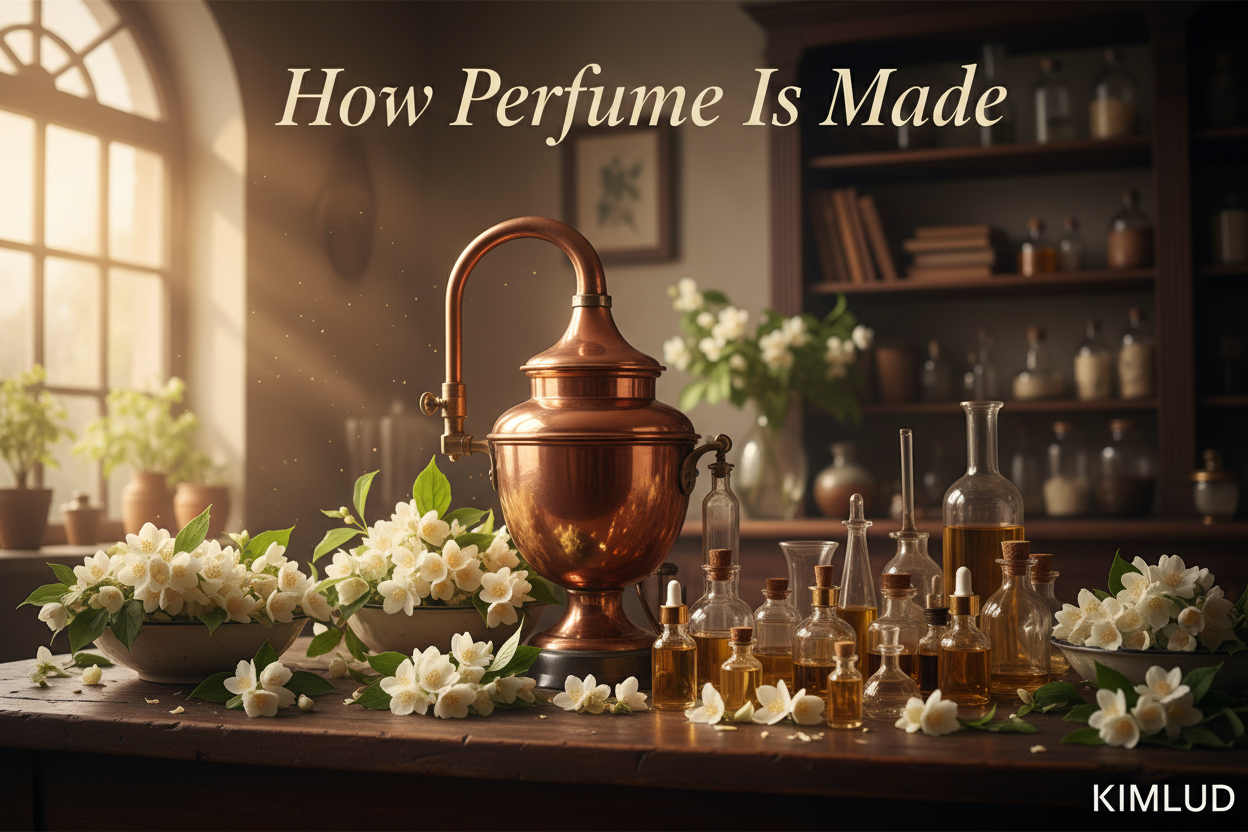
How Perfume Is Made: From Flower to Fragrance
How Perfume Is Made: From Flower to Fragrance
Behind every bottle of perfume lies an extraordinary journey — from fields of flowers harvested at dawn to the laboratory of a master perfumer. Discover the complete art and science of perfume creation.
Explore KIMLUD Fragrances
Table of Contents
- Raw Materials: The Building Blocks of Perfume
- Extraction Methods
- Steam Distillation
- Solvent Extraction
- Enfleurage: The Ancient Method
- Cold Pressing
- CO2 Extraction
- Synthetic Aromatic Molecules
- The Perfumer: Nose and Artist
- The Composition Process
- Evaluation and Refinement
- Industrial Production
- Frequently Asked Questions
- References & Further Reading
Raw Materials: The Building Blocks of Perfume
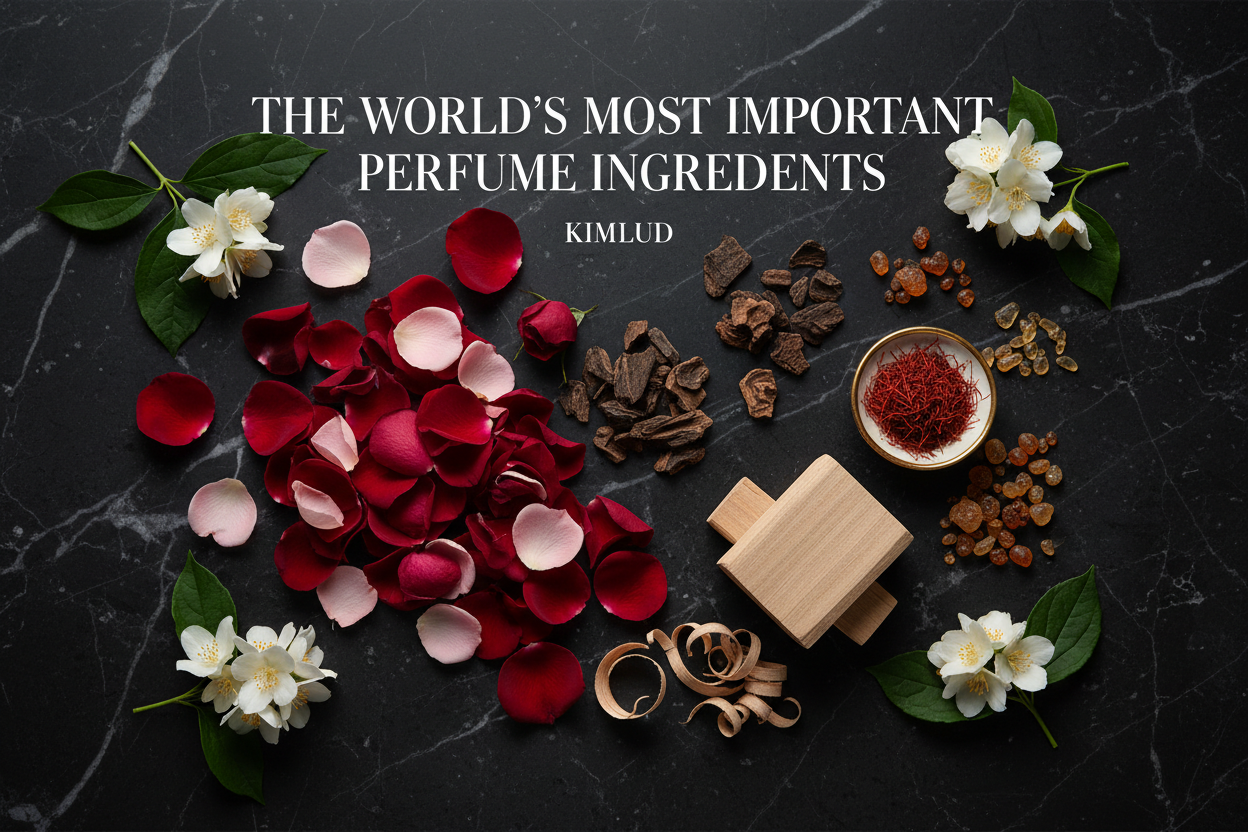
A modern fine fragrance may contain anywhere from 20 to over 200 individual aromatic ingredients — natural raw materials derived from plants, animals, and minerals, plus synthetic aromatic molecules created in the laboratory.
Extraction Methods: How Aromatic Compounds Are Obtained

Different materials require different extraction methods, depending on the nature of the aromatic compounds, their concentration, and their sensitivity to heat and chemical processes.
Steam Distillation
Steam distillation is the most widely used method for extracting essential oils. Steam passes through plant material, vaporizing aromatic compounds which then condense and separate from water as essential oil.
| Step | Process | Equipment |
|---|---|---|
| 1. Loading | Plant material placed in still with water | Distillation still (alembic) |
| 2. Heating | Water heated to produce steam | Heat source |
| 3. Vaporization | Steam carries aromatic molecules upward | Still head and swan neck |
| 4. Condensation | Steam cooled back to liquid | Condenser coil |
| 5. Separation | Oil floats on water surface | Florentine flask |
| 6. Collection | Essential oil collected separately | Collection vessels |
Solvent Extraction
Used for delicate flowers like jasmine and tuberose whose aromatic compounds are too fragile for steam distillation. The process produces a concrete, then an absolute — a highly concentrated, intensely aromatic liquid that captures the full complexity of the flower's scent.
Enfleurage: The Ancient Method

Enfleurage is one of the oldest extraction methods, spreading fresh flower petals on fat-coated glass frames to absorb aromatic compounds. The resulting pomade is washed with alcohol to produce an enfleurage absolute of extraordinary quality. Today it is practiced by only a handful of artisan perfumers, primarily in Grasse, France.
Cold Pressing
Used exclusively for citrus peels. Mechanical pressure releases aromatic compounds from tiny sacs in the outer peel, producing fresh, bright, true-to-fruit citrus oils.
CO2 Extraction
Supercritical CO2 extraction uses carbon dioxide under high pressure to extract aromatic compounds. It produces materials of exceptional quality with a scent closer to the living plant than any other method.
Synthetic Aromatic Molecules
The first important synthetic aromatic molecule was coumarin, synthesized in 1868. Today the fragrance industry uses thousands of synthetic molecules produced by major ingredient companies including Givaudan, Firmenich, IFF, Symrise, and Takasago.
The Perfumer: Nose and Artist
Professional perfumers — called "noses" — train for 5 to 10 years, memorizing hundreds of individual aromatic materials. A professional perfumer typically has a working palette of 1,000 to 3,000 individual aromatic materials. The most prestigious perfumery school is ISIPCA in Versailles, France.
The Composition Process
Fragrance creation begins with a brief describing the desired character, target audience, and olfactory direction. The perfumer creates initial trials, evaluates them on blotters and skin, and refines through multiple iterations. This process can take weeks to years.
Evaluation and Refinement
Fragrances are assessed by the perfumer, brand teams, consumer panels, and regulatory bodies. IFRA standards restrict certain aromatic materials identified as potential allergens, and perfumers must ensure compliance.
Industrial Production
The fragrance concentrate is diluted with alcohol and water to the desired concentration, chilled, filtered, and allowed to macerate before filling into bottles. Quality control checks are performed at every stage.
Frequently Asked Questions
How long does it take to create a perfume?
Creating a new fragrance can take anywhere from a few weeks to several years. Major luxury fragrance launches often involve years of development.
What is the difference between an essential oil and an absolute?
Essential oils are produced by steam distillation. Absolutes are produced by solvent extraction and have a richer, more complex scent suitable for perfumery.
What is enfleurage?
An ancient extraction method using fat to absorb aromatic compounds from delicate flowers. It produces exceptional quality but is extremely labor-intensive and rarely used today.
What does a perfumer do?
A perfumer creates fragrance compositions by blending natural and synthetic aromatic materials. Training typically takes 5 to 10 years.
Are synthetic fragrances inferior to natural ones?
Not necessarily. The finest modern fragrances typically combine both natural and synthetic ingredients to achieve the best possible result.