


KIMLUD Lifestyle — Historical Series
From Icebox to AI
The Complete History of Home Appliances (1900–2026)
A 120-year visual journey through the inventions that transformed how humanity lives, cooks, cleans, and connects — at home.
Imagine waking up in 1900. No refrigerator hums in the kitchen. No washing machine churns in the utility room. No microwave, no television, no smartphone. The home — particularly for women — was a place of relentless, unending manual labor. Historians estimate that household work consumed the majority of a woman's waking hours.
Then electricity arrived. And everything changed.
Over the next 120 years, a parade of extraordinary inventions would liberate humanity from drudgery, reshape family life, redefine comfort, and ultimately connect every home on Earth to a global intelligence. This is that story — told through the machines that made it happen.
ℹ️ Editorial note: Many inventions in this article were preceded by earlier prototypes or patents. Where possible, we use the date of widespread commercial adoption rather than the earliest known patent. Dates marked with ≈ indicate approximate or debated timelines.
⚡ The Electric Dawn (Early 1900s–1920s)

🔌 ≈1882–1905 — The Electric Iron

Henry W. Seeley patented an electric flatiron as early as 1882, but early models were impractical. By the early 1900s, the electric iron became one of the first widely adopted household electric appliances. Entrepreneur Earl Richardson helped popularize it by convincing his local California power company to supply electricity on Tuesdays — ironing day — making it practical for ordinary households.
🫧 1908 — The Electric Washing Machine


The Thor, introduced in 1908 and designed by Alva J. Fisher, became one of the first commercially successful electric washing machines. Laundry had been an all-day affair of boiling water and scrubbing boards. Economist Ha-Joon Chang has argued the washing machine was more transformative than the internet — because it freed billions of hours of human labor, primarily women's.
🌀 ≈1907–1908 — The Portable Electric Vacuum Cleaner

James Murray Spangler developed one of the first portable electric vacuum cleaners around 1907–1908, building on earlier large industrial models. He sold the patent to William Hoover, whose name became so synonymous with vacuuming that "hoovering" entered the English dictionary as a verb.
🍳 By the 1910s — The Electric Stove

Electric cooking demonstrations date back to the 1890s (Thomas Ahearn demonstrated an electric stove in 1892), but by the 1910s electric stoves began entering middle-class homes in meaningful numbers. They eliminated smoke, ash, and the need to tend a fire — transforming the kitchen from a hot, dangerous workspace into the warm social heart of the home.
🎂 1919 — The Home Stand Mixer

KitchenAid popularized the home stand mixer in 1919 with its H-5 model, though commercial stand mixers had existed before. It democratized baking by replacing 20–30 minutes of hand-beating with the push of a lever — sparking a home cooking revolution that continues today.
📻 Early 1920s — Mass Radio Broadcasting
Radio technology predates the 1920s, but commercial broadcasting — beginning with KDKA Pittsburgh in 1920 — transformed the radio into the first mass connected home technology. By 1930, over 12 million American homes had a radio receiver, making it the first appliance that brought the outside world into the living room.
❤️ The Gender Revolution Hidden in Plain Sight

It is impossible to tell the history of home appliances without acknowledging what it really was: a revolution in women's labor.
Before electrification, the average household required enormous physical effort to maintain. Laundry alone could consume an entire day. Cooking required constant fire management. Cleaning was manual and exhausting. This work fell almost entirely on women — whether as wives, mothers, or domestic servants.
Each appliance introduced in this article represents not just a technological milestone, but hours of human life returned to the people who had been spending them on drudgery. The washing machine, the vacuum cleaner, the dishwasher — these were not merely conveniences. They were, quietly and profoundly, instruments of liberation.
🏠 The Age of Comfort (1927–1950)
❄️ 1927 — The Mass-Market Electric Refrigerator
Mechanical refrigeration had existed since the 19th century, but GE's Monitor Top (1927) brought it to the mass market at a price ordinary families could afford. Before it, families relied on iceboxes — literal blocks of ice delivered by horse-drawn carts. By 1944, approximately 85% of American homes had an electric refrigerator, fundamentally changing how humans shop, cook, and eat.
🌀 1937 — The Fully Automatic Washing Machine

Bendix introduced the first fully automatic washing machine in 1937 — no hand-cranking, no manual wringing. You loaded it, set the dial, and walked away. This single advancement is estimated to have saved households several hours of labor per week.
🥤 1937 — The Blender
The Waring Blendor, co-developed with bandleader Fred Waring, was originally marketed for making cocktails. It quickly became a kitchen staple. Today blenders are among the most common kitchen appliances worldwide.
⏱️ 1939 — The Pressure Cooker
Pressure cooking technology dates to the 17th century, but the modern stovetop pressure cooker became a household staple in the late 1930s, dramatically reducing cooking times. The modern Instant Pot is its direct descendant.
📺 Post-WWII — The Television


Television technology was demonstrated in the 1920s and 1930s, but mass consumer adoption came after World War II. By 1960, approximately 90% of US households had a TV. It restructured family life, created shared cultural moments, and became the centerpiece of the living room for half a century.
🍽️ 1950s — The Home Dishwasher

Josephine Cochrane invented a practical dishwasher in 1886, but it took until the postwar economic boom for dishwashers to enter ordinary homes at scale. Modern studies suggest dishwashers use less water than hand-washing — a fact that still surprises most people.
🚀 The Space Age Home (1950s–1970s)
🌡️ 1950s — The Programmable Thermostat

Automatic temperature control technology developed gradually through the mid-20th century. The programmable thermostat introduced a key concept: a home appliance that responds to your schedule rather than requiring constant manual adjustment. It was an early step toward the automated home.
❄️ 1950s — The Room Air Conditioner

Window air conditioning units became widely affordable in the 1950s. Air conditioning has profoundly shaped where humans choose to live and work — the growth of cities like Phoenix, Houston, and Dubai is inseparable from it. It also changed social habits, as families moved indoors during summer months.
☕ 1950s — The Automatic Electric Kettle

The automatic kettle with thermal cutoff — which boils water and switches itself off — became a staple of British and European homes. It remains one of the most-used electric appliances in the UK, found in the vast majority of households.
📡 1967 — The Home Microwave Oven

Microwave cooking was discovered accidentally in 1945 when engineer Percy Spencer noticed a chocolate bar melting near an active radar magnetron. The first consumer microwave oven reached homes in 1967. Adoption was initially slow due to cost, but by the 1980s it had become a kitchen standard across much of the world.
☕ 1972 — The Automatic Drip Coffee Maker

Mr. Coffee, launched in 1972, made automatic drip coffee a morning ritual for millions of households. It replaced the stovetop percolator and became one of the defining kitchen appliances of the 1970s and 1980s.
📼 1970s — The Home Video Recorder (VCR)
The VCR gave people control over television for the first time — you could record a programme and watch it later. This was the birth of time-shifted media consumption, the conceptual ancestor of Netflix and on-demand streaming. The VHS vs. Betamax format war of the late 1970s was one of the first major consumer technology standards battles.
💻 The Digital Revolution (1980s–2007)
🖥️ 1980s — The Personal Computer

The IBM PC (1981) and Apple Macintosh (1984) brought computing into family homes. The personal computer was the most complex appliance ever introduced into domestic life — and it would eventually absorb and replace dozens of others: the typewriter, encyclopedia, photo album, music player, and telephone.
📞 1980s–1990s — The Cordless & Mobile Phone
The cordless phone freed communication from the wall socket. By the 1990s, mobile phones began entering homes, planting the seed of an idea that would fully bloom with the smartphone: what if you never needed to be in a specific place to communicate?
🌐 Mid-1990s — The Internet Arrives at Home
Consumer internet access via dial-up modems became widely available in the mid-1990s. The internet did not just add a new appliance — it began the process of making every other appliance smarter, more connected, and more powerful. The home would never be isolated again.
🥨 2001 — The Robot Vacuum (Roomba)

iRobot launched the Roomba in 2002, introducing the first widely adopted autonomous home robot. It was the first appliance that could navigate a home independently — a glimpse of the autonomous household to come.
📱 2007 — The Smartphone

Apple introduced the iPhone in January 2007. The smartphone compressed the entire history of home appliances into a single pocket device — camera, music player, telephone, computer, television, radio, alarm clock, map, and encyclopedia in one. It also became the remote control for the smart home that was about to arrive.
🤖 The Smart Home Era (2010–2026)
🌡️ 2011 — The Smart Thermostat (Nest)

The Nest Learning Thermostat, launched in 2011, was the first mainstream smart home device. It learned your schedule, adjusted automatically, and could be controlled remotely via smartphone. It marked the beginning of the connected home as a consumer reality rather than a futurist concept.
🍟 2010 — The Air Fryer

Philips launched the air fryer in 2010. It uses rapid air circulation to cook food with significantly less oil than traditional frying. By the early 2020s it had become one of the fastest-adopted kitchen appliances in recent history, particularly popular in North America and Europe.
🗣️ 2014 — The Voice Assistant (Amazon Echo)

Amazon's Echo and Alexa (2014) made voice-controlled home automation mainstream. For the first time, you could control lights, thermostat, music, and shopping lists by simply speaking. Voice assistants have since been adopted by hundreds of millions of households worldwide.
🧠 2022–2026 — The Generative AI Era

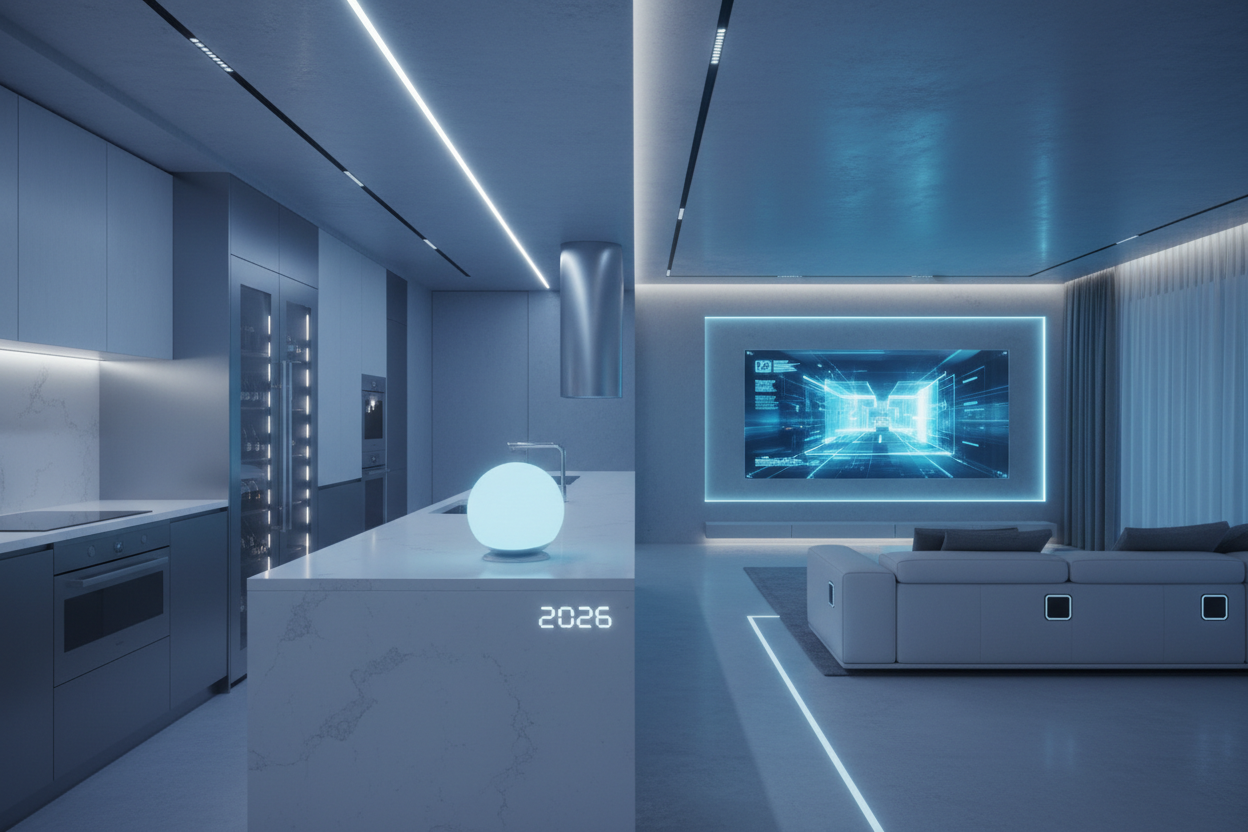
The launch of ChatGPT in late 2022 marked a new phase in home technology. By 2024–2026, AI capabilities began integrating into appliances — refrigerators that suggest recipes, washing machines that optimize cycles, security systems that distinguish between people and pets. The home appliance has completed its ultimate evolution: from a tool that does what you tell it, to a system that understands what you need.
The 120-Year Timeline
What Comes Next?
The home of 2030 will likely be unrecognizable to someone from 2010. AI systems will manage energy consumption, predict maintenance needs, personalize environments for each family member, and connect every appliance into a single intelligent ecosystem.
The question is no longer what can our homes do? — but what do we want our homes to become?
At KIMLUD, we believe the home is the most important space in your life. That's why we curate the finest home decor, furniture, lighting, and living essentials — pieces that don't just fill a room, but define it.
✨ Elevate Your Home with KIMLUD
From statement furniture to ambient lighting, artisan ceramics to smart home accessories — discover pieces that make your home extraordinary.
❓ Frequently Asked Questions
What was the first electric home appliance?
Electric irons and fans were among the earliest electric home appliances, with patents dating to the 1880s. Widespread consumer adoption of electric appliances began in the early 1900s as electricity networks expanded into homes.
Which home appliance had the biggest impact on society?
Economist Ha-Joon Chang has argued the washing machine was more transformative than the internet, because it freed billions of hours of human labor — primarily women's — over the past century.
What is a smart home appliance?
A smart home appliance connects to the internet and can be controlled remotely, programmed automatically, or operated via voice commands. Examples include smart thermostats, connected washing machines, and AI-powered kitchen devices.
What will home appliances look like in 2030?
By 2030, most new appliances are expected to feature AI integration, energy self-management, and full interconnectivity. Refrigerators may automatically reorder groceries; ovens may suggest recipes based on available ingredients.
📚 Sources & Further Reading
- Ha-Joon Chang, "The net isn't as important as we think" — The Guardian, 2010
- Wikipedia: Thor washing machine, James Spangler, History of the vacuum cleaner
- Smithsonian Institution: History of Home Appliances
- US Energy Information Administration: Residential Energy Consumption Survey
- iRobot: Roomba product history


%0AA%20120-year%20visual%20journey%20through%20the%20inventions%20that%20transformed%20how%20humanity%20lives,%20coo...)